
Setting up an effective homework environment
A good place to work will get good work in place.
Where?
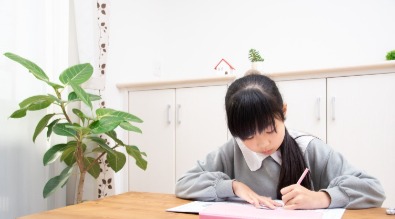
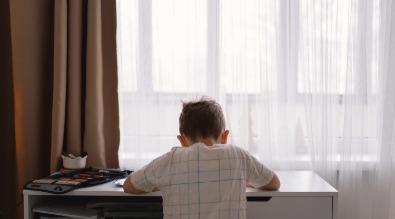
So, where can we set up an effective homework environment? Anywhere really, but be aware of distractions. A desk in the bedroom can work well but there can also be more interesting things to do (and see: screens...) than homework. It is difficult to monitor how the work is going as often children don't appreciate their parent coming into their rooms to check up on them. A communal area such as the kitchen, dining room or living room can work well as the presence of other people gives subtle reassurance and you are on hand to help if needs be (we'll talk more about this later).
Unless siblings are able to get on with whatever they are doing quietly, think about having them somewhere else in the house. Make sure there are no screens around as it is very difficult to focus on the task in hand with the telly on or brother playing on the Xbox. Ideally you can be getting on with something in the vicinity so as to keep an eye on things and be there to help. Make sure any table or desk is clear and has all the stationery and equipment that may be needed so as not to provide excuses to go upstairs and look for a ruler/pencil/rubber/etc. Other things to check are that there is enough light and your child is sufficiently fed and watered. Now it's time to get on with it.
How?
Ideally you want your child to put their head down, work hard and produce a great piece of accurate, neatly presented work while you get on with whatever you want. Unfortunately, this tends to be the exception rather than the norm but how can we head towards this goal? Well, there are a number of things you can do. First, establish a routine. We've seen that successful homeworkers tend to do their homework at the same time each week in the same place so they are expecting to do it and it becomes a fixed part of their day. Set a fixed time and try and get as much done as you can in that time, it is okay to not finish a piece of homework and come back to it later. Break the session up into shorter sections if needs be, this is particularly helpful for children who struggle to focus for extended periods. Get a timer and work in 10 or 5 minute bursts. Egg timers are good for this as you can see how much time has elapsed/is left visually. If you do this the breaks are short, just a minute or two to walk around the room, have a drink, go to the loo, not start something else leisure orientated.
What we're really aiming for is for children to eventually take total responsibility for their homework and get it done independently without you being involved. No one wants to be arguing about homework every day when children move on to secondary schools. However, first your child needs to have the confidence to approach any work and give it a go and the perseverence to stick with it even when it is difficult, boring or there is something more interesting to do.


So, how much should you help your child? Well, enough to support them and help their confidence but not so much that they are completely reliant on your input. Obviously this will vary with each child and how far through school they are; younger learners tend to need more help than older ones. It is a good idea to sit down and go through what needs to be done and make sure everyone knows exactly what to do. Get your child to explain to you what they have to do and how they are going to do it. Homework tends to relate to recent lessons as its general purpose is consolidation of learning rather than introducing new concepts. Ask when it was taught at school, who the teacher was, or any other ways you can make a link with the lesson to help trigger memories. Sometimes your child will be able to get straight on with it - encourage this but suggest you come back after they have done a few questions to check they are getting it right (you would be amazed how often children crack on with a piece of work in a cheerful, confident manner only to reach the end having had no real clue what they are doing...). If they can't get started or are really struggling, then by all means go through a couple of questions with them (or watch a relevant Help me do my Homework video lesson) so they are clear how to do it. Then, ideally, get up and leave them to it; remember, it is independence we are aiming for here. Be on hand to answer any questions and look over anything, just being around can be a real help. Keep an eye out for sloppy work - careless presentation can (but not always - you'll know what your child is capable of) indicate careless thinking. Don't just give the answers, and if you are both stuck then get help, either from us or from your child's teacher. Encourage your child to ask for help directly, it is much better for them to take responsibility for this than you firing off an email to the teacher saying that Jemima struggled with her homework and could it be gone over again. Taking responsibility for learning is a key skill and what we are trying to do in the classroom is get young learners to become aware of what they can and can't do and the steps they need to overcome obstacles and problems.
Summary
Managing homework can be challenging, especially with children who struggle to focus or are disinterested. However, it needs to be done and the amount will only increase, so the sooner you can establish a sound practice in your household, devoid of threats and tantrums, the better. We hope our site will help you do your homework.
- Choose a quiet and distraction-free place to work, such as a desk in the bedroom or a communal area like the kitchen or living room.
- Make sure there are no screens around and siblings are doing something quietly elsewhere in the house.
- Ensure the workspace is well-lit and your child is fed and hydrated.
- Establish a routine and set a fixed time for doing homework each week, ideally at the same place and time.
- Break the homework session into shorter periods if necessary, working in 5-10 minute bursts.
- Encourage your child to take responsibility for their homework by explaining what needs to be done and how to do it.
- Help your child when needed but avoid doing the work for them.
- Be on hand to answer questions and provide support.
- Encourage your child to take responsibility for their own learning and to ask for help when needed.


